
How to strengthen a polytunnel against wind and snow
Three components strengthen a polytunnel: lattice cables (3 mm steel cables from leg to hoop) against wind, a Ø35×1.5 mm ridge tube against the hoops spreading, and horizontal bracing from Ø40×1.5 mm tube in a T or V version, which forms a truss with the hoop and strengthens the tunnel most against snow. Multibay tunnels have lattice cables as standard; single tunnels have a ridge tube.
Wind tries to overturn the tunnel and lift the film; snow presses down on the hoops and pushes them outwards. Each of these loads calls for a different reinforcement. Below we describe the three we fit, and what comes as standard on each type of tunnel.
What is standard and what is optional
| Reinforcement | Multibay tunnels (Multibay) | Single tunnels (Solo) |
|---|---|---|
| Lattice cables | standard | not used |
| Ridge tube | option | standard |
| T or V horizontal bracing | option | option |
The three reinforcements at a glance
| Reinforcement | Made from | Where | What it counters |
|---|---|---|---|
| Lattice cables | 3 mm steel cable | from leg to hoop, on every hoop | wind, partly snow |
| Ridge tube | Ø35×1.5 mm tube | 20 or 40 cm below the apex, along the full length of the tunnel | hoops spreading |
| T or V horizontal bracing | Ø40×1.5 mm tube (4–7 m), T and V pieces from Ø35×1.5 mm tube | on every hoop | snow |
Lattice cables — standard in multibay tunnels
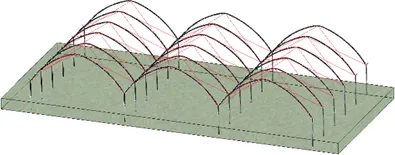
Lattice cables are 3 mm steel cables running from the leg to the hoop. On every hoop they form a network inside the tunnel, rather like a spider’s web. The network stiffens the structure, so the tunnel holds up better in wind. The cables also help with snow, but less than tube bracing.
We fit lattice cables as standard in multibay tunnels. We do not use them in single tunnels.
Ridge tube — standard in single tunnels
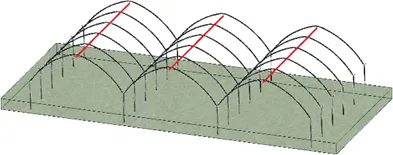
The ridge tube runs along the full length of the tunnel, 20 or 40 cm below the apex of the hoops. It ties all the hoops together at the top, so they do not spread outwards under load. It is a Ø35×1.5 mm round tube.
In single tunnels the ridge tube is standard. In multibay tunnels it is an option that customers often choose.
Horizontal bracing in the T or V version — an option for both types
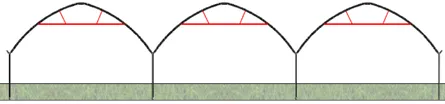
Horizontal bracing is a Ø40×1.5 mm tube that joins both sides of the hoop in its upper part. It is 4 to 7 m long, depending on the bay width. We fit it on every hoop.
We also connect the brace to the hoop in one of two ways (the drawing shows the V version):
- T — a vertical tube from the horizontal brace to the hoop,
- V — two short diagonal braces, on the left and right, from the horizontal brace to the hoop.
We make the T and V pieces from Ø35×1.5 mm tube. Both versions are similarly effective. Together with the hoop, the bracing forms a truss that strengthens the tunnel very considerably against snow.
The strongest combination in multibay tunnels
The most strongly reinforced multibay tunnel has lattice cables and horizontal bracing, ideally in the T or V version. The cables hold the structure in the wind, and the truss formed by the bracing and the hoop carries the weight of snow.
A single tunnel already has a ridge tube as standard. For snow, add T or V horizontal bracing.
What else affects tunnel strength
Reinforcements are one of several decisions. Strength is also affected by:
- Arch shape. The Cornell University guide states that snow slides off the pointed roof of a gothic tunnel better than off a round arch. The same guide notes that gothic tunnels, being taller and more exposed, need additional bracing to cope well with wind.
- Hoop spacing. The University of Missouri states that, with the same tube diameter, a tunnel with hoops every 4 feet (about 1.2 m) is clearly stronger than one with 6-foot (about 1.8 m) spacing.
- Hoop tube profile. A 90×50 mm oval tube gives +29% strength compared with 80×40 mm, at a similar price.
- Steel for legs and anchors. We make legs and anchors from E370+Z275 steel, about 10% stronger than S350+Z275, at the same price. Hoops are made from S350+Z275 steel.
How to choose reinforcements for your field
We choose the reinforcements during a visit to the customer, together with the tunnel type, bay width, tube profile and arch shape. What matters is where the field lies, the crop, and whether the tunnel stays up over winter. Start with the configurator or call us: +48 512 208 808.
Sources
- Structures — Cornell High Tunnels (Cornell University) (accessed 11 October 2026)
- Snow Removal From High Tunnels — D. Trinklein, University of Missouri, Missouri Environment & Garden (accessed 11 October 2026)